Reduction (orthopedic procedure)
Procedure to realign broken bones or dislocated joints.

Orgmetchem · CC0
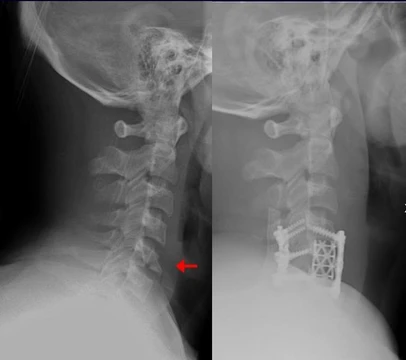
Reduction is a medical procedure to restore the correct anatomical alignment of a fracture or dislocation. When an injury results in a displaced fracture or a joint dislocation, reduction is required for effective healing. The procedure can be performed as a closed reduction (external manipulation without opening the skin) or an open reduction (surgical internal manipulation).
- field
- Orthopedic medicine
- known_for
- Restoring anatomical alignment of fractures and dislocations
- types
- Closed reduction, open reduction, dislocation reduction
- common_medications
- Ketamine, Midazolam, fentanyl, propofol, etomidate, lidocaine, NSAIDs, acetaminophen
- risks
- Further damage, unsuccessful reduction, infection, hardware failure, adverse anesthesia reactions
Lore & Background
Reduction is performed for both displaced fractures and joint dislocations. Closed reduction involves external manipulation without opening the skin, often done in the emergency department with local anesthetic. Open reduction is a surgical procedure requiring internal manipulation and often fixation with hardware. Dislocation reduction applies traction to the distal bone to relax muscles and create space for relocation.
Reader's Guide
Reduction is a cornerstone of orthopedic care, enabling proper healing of fractures and dislocations. Closed reduction avoids surgical incision and is common for injuries like distal radial fractures. Open reduction allows direct access for complex fractures and often includes fixation. Dislocation reduction techniques vary by joint but share the principle of traction. Procedural medications range from local anesthesia to conscious sedation or general anesthesia. Risks include damage to surrounding structures, unsuccessful reduction, and complications from medications or surgery. Recovery after closed reduction involves pain for 2–3 weeks, with milder pain up to 12 weeks.
Did You Know?
- Closed reduction is not a surgical procedure and is often performed in the emergency department.
- A distal radial fracture (wrist) is a common injury requiring closed reduction.
- Traction for dislocation reduction can be applied by human strength or with a system of pulleys and weights.
- Ketamine and Midazolam are common choices for pediatric conscious sedation during reduction.
Purpose and the Dominant Technique
Arthroplasty, a term derived from the Greek for re-forming of a joint, represents a category of orthopedic surgery aimed at correcting damaged articular surfaces. Whether through replacement, remodeling, or realignment via osteotomy, the overarching goal remains consistent: alleviating pain and restoring functional movement to a joint compromised by arthritis or traumatic injury. As an elective procedure, it is not performed in emergency settings but rather as a planned intervention for patients whose quality of life has been significantly diminished. Over the past four and a half decades, the most widely performed and successful variant has been the complete or partial substitution of a degenerated joint surface with a prosthetic implant. A classic illustration is total hip arthroplasty, in which both the acetabular socket and the femoral head and neck are exchanged for artificial components. The clinical objectives extend beyond pain relief to encompass restored range of motion, improved gait mechanics, and consequently, the recovery of surrounding muscle strength.
A Spectrum of Surgical Approaches
While prosthetic replacement dominates modern practice, arthroplasty encompasses a broader family of techniques that address joint dysfunction in distinct ways. Interpositional arthroplasty, once a favored approach, involves inserting a biological barrier such as skin, muscle, or tendon between opposing joint surfaces to prevent inflammatory contact. Excisional or resectional arthroplasty takes a more radical path, removing the damaged joint surface and underlying bone entirely; the residual bone ends may be sutured together or simply left to allow scar tissue to bridge the gap. A specific variant, the Stainsby procedure, targets the metatarsophalangeal joint by excising part of the proximal phalanx, reducing the plantar plate, and stabilizing the metacarpal to the remaining phalanx with a Kirschner wire. Resurfacing arthroplasty offers a middle ground, trimming one or both bone surfaces and capping them with a smooth metallic shell. Additional methods include mold arthroplasty, silicone implant replacement, and osteotomy procedures designed to restore or alter joint congruity.
Engineering the Artificial Joint
The design and manufacture of joint prostheses present an ongoing engineering puzzle that sits at the intersection of materials science and surgical practice. An ideal implant must be simultaneously nontoxic, mechanically resistant, biocompatible, and durable, yet satisfying all of these criteria in a single material system has proven extraordinarily difficult. As a practical benchmark, approximately 75 percent of artificial knees remain functional after two decades, while 90 percent endure a decade of use, underscoring that even the best implants face a finite service life. Recent advances have addressed some of these limitations. Porous-coated prostheses, for instance, promote stronger biological bonding with surrounding bone. Perhaps more transformative has been the integration of computer-assisted design and manufacturing workflows. By leveraging patient-specific X-rays, advanced imaging scans, and modern 3D printing technology, surgeons and engineers can now fabricate individually tailored prosthetic components, moving the field closer to truly personalized joint reconstruction.
Indications and Complications
The decision to pursue arthroplasty is typically driven by a defined set of pathological conditions. Osteoarthritis and rheumatoid arthritis represent the most common indications, but the list extends to avascular necrosis, also termed osteonecrosis, congenital hip dislocation, acetabular dysplasia characterized by a shallow hip socket, frozen or loose shoulder, joints damaged by trauma and left malaligned, and severe joint stiffness. Despite the elective nature of the surgery and the sophistication of modern implants, the procedure carries a spectrum of potential complications. Patients face risks including deep vein thrombosis and other blood clots, postoperative infection, significant bleeding, periprosthetic fractures around the implant, progressive loosening of the prosthesis from the bone, mechanical wear of the articulating surfaces, and ultimately complete implant failure. These risks are not merely theoretical; they represent the continuous clinical challenges that drive ongoing research into better materials, improved surgical techniques, and more reliable long-term outcomes.
Gallery





Frequently Asked Questions
Who is Reduction (orthopedic procedure)?
Reduction is a core orthopedic intervention designed to put a displaced bone fragment or a dislocated joint back into its proper anatomical position. It sits at the heart of fracture and dislocation management in musculoskeletal medicine.
What are Reduction's powers/role?
Its primary role is to realign broken bone segments or reposition a joint so that natural healing can proceed correctly. It can be executed as a closed technique (manipulating from the outside) or an open technique (surgically exposing the site for direct repositioning).
How does Reduction's story end?
A successful reduction restores the bone or joint to its original configuration, allowing surrounding soft tissues and periosteum to guide proper bony union. If alignment remains inadequate, the patient may require repeat attempts or conversion to surgical fixation with hardware.
Why is Reduction important?
Without restoring proper alignment, a fracture heals in a malposition that can permanently impair joint function, load-bearing capacity, and range of motion. It is therefore a critical early step before any definitive fixation, casting, or bracing is applied.
What are Reduction's known weaknesses/risks?
Potential complications include iatrogenic soft-tissue or neurovascular injury, failure to achieve adequate alignment, post-procedural infection when the open approach is used, and adverse reactions to the sedation or analgesic agents commonly administered during the maneuver.
More in Musculoskeletal System And Orthopedics 1-17
Spotted an error? Know more?
This is a living reference — every entry is fact-audited, and reader corrections feed straight into our audit queue. Suggest an edit · See this site's audit record